
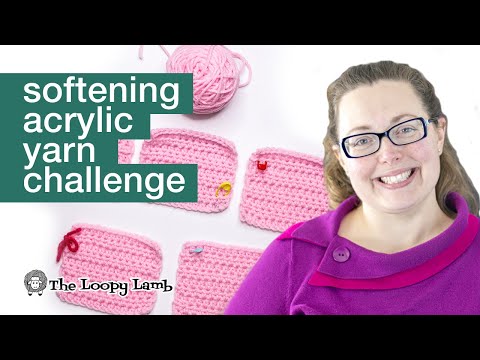
One of the most frequent questions that I’ve gotten in the past few weeks from folks is “how do you soften acrylic yarn?”. There are a few different ways that I’ve seen it done so I decided to try all of the ways I’ve heard about softening acrylic yarn – both before and after crocheting or knitting your projects and share those results with you here.
I’m going to walk you through each method I used for softening acrylic yarn and then I’ll share with you which one(s) I think gives the best results.
Pin This to Save It For Later Save It
This post may contain affiliate links. This means that I may earn a small commission from qualifying purchases made through these links at no extra cost to you.
Many of us have one or two skeins in our stash that are that scratchy acrylic yarn that we bought when we were getting started or had gifted to us that we just don’t want to use. You know the one I’m talking about.
Most people who have asked about softening acrylic yarn skeins have mentioned Red Heart Super Saver yarns so I am using that yarn in all of my experiments.
I have created the same swatch to use in all of our experiments and I have one swatch that I have kept aside as a “control” swatch so that we have something to compare our swatches and yarn to after running our experiments.
Table of contents
Properties of Acrylic Yarn
Acrylic yarn is a synthetic fiber that crafters value for its durability, affordability and wide range of colors. Folks that have allergies to natural fibers like cotton and wool tend to use acrylic yarn because it is hypoallergenic. While acrylic yarn has come a long way in recent years, there are still some yarns that are not as soft as we would like them to be which may leave you wondering how you can improve the softness of your acrylic yarn.
So we’ll be covering all the different softening methods to help you decide which you may want to try and which works the best.

How to Soften Yarn in a Skein:
So this method involves softening the entire skein of yarn BEFORE crocheting with it. Here’s how you do it:
- Remove the labels from your yarn.
- Fluff up the skein with your fingers
- Pop it in a lingerie bag (or pillowcase) and wash it in cold water and fabric softener
- Place the bag in the dryer with a dryer sheet
I was nervous about doing this as I know others that have done this exact method and thrown the entire skein of yarn away because it became a tangled mess. But, I did it anyways and instead of using a yarn skein, I caked some yarn up with a yarn winder and then followed the above steps.
Did It Work?:
Technically yes, however, my yarn did become a bit unravelled and the effect was minimal. I would be concerned about using a bigger skein and having a tangled disaster at the end.
I’d recommend using one of the below methods to soften your scratchy yarn instead.

How to Soften Crochet Projects Made with Acrylic Yarn (Softening AFTER the project is done):

How to Soften Acrylic Yarn with Fabric Softener
To soften your yarn using fabric softener follow these steps:
- Throw your finished project into the washing machine and add some fabric softener to the machine. Usually a single capful of fabric softener will suffice but be sure to check the fabric softener bottle for the correct amount for your brand.
- When done, put your project in the dryer.
Did It Work?
Yes, a little bit. This was the least effected swatch in all of the experiments. The feel of the yarn was slightly softer but barely enough to notice.
Excess softener can leave a residue on your project so if you find that it has left a film, it may need to be washed again.
How to Soften Acrylic Yarn with Vinegar:
To soften your yarn using vinegar follow these steps:
- Add 1 tablespoon of white vinegar to 4 cups of cool water.
- Soak your complete project in the vinegar solution for at least 20 minutes.
- Remove your project from the solution and rinse it out with cool water. (If your project still smells like vinegar after rinsing, you can add your project to the washing machine.)
- Dry your project in the dryer on low.
Tip: If you use a larger project, you may want to use as much as 1 cup of white vinegar to 4 cups of water. If you find that you can smell the vinegar after washing, try running it through an additional rinse cycle or washing it with a gentle detergent.
Did It Work?
Yes. There was no vinegar scent and the yarn was softened a little bit. Not as much as other methods but could absolutely work in a pinch.
Does Your Yarn Color Bleed?
If you find that the color is bleeding from your project, adding one part vinegar to 4 parts water can actually help stop the yarn color from bleeding out. I like to use vinegar to soak baby items if I find that the color is bleeding in vinegar. I feel like it helps give the color a bit more longevity. After soaking, I wash it as normal.
Free Crochet Patterns You’ll Love


Softening Yarn with Conditioner:
Here is how to soften acrylic yarn using conditioner:
- After finishing your project, fill a bowl/basin/sink with lukewarm water.
- Submerge your project into the warm water and let it sit for a few minutes.
- Add a couple of squirts or pumps of whatever hair conditioner you have on hand to your project and mix it into the water. A small amount of hair conditioner can go a long way.
- Rub some conditioner into the actual project.
- Let the project soak for 30 mins or more (some people leave it overnight!)
- Rinse the project out and roll it into a towel and gently remove the excess water by squeezing it.
- At this point, you can either block your project or throw it in the dryer (depending on your project i.e. block garments).
Did It Work?
Yes – this swatch was the softest of all of the ones tested. It was a bit messy and was the most involved process of all of the methods I tried.
It’s impractical for large project unless you’re willing to massage conditioner into every inch of that project to get good coverage. Additionally, the pre-soaking process can be diffcult unless you have a large vessel for it (like a tub). Ideal for smaller projects that would be worn next to skin. Some conditioners can leave a residue on your project and, depending on the conditioner used, it can be the priciest of the options.
Additional Way to Use Gentle Conditioner for larger projects: A reader wrote to me after publishing this piece to share how she uses hair conditioner for her larger projects: She uses a dollar store hair conditioner that keeps it cheap, while also working well for her sensitive skin, puts it into a spray bottle with 4 parts water to hair conditioner. She shakes up the mixture before using it and uses it to spray her blankets. After she is happy with the amount of moisture in her fabric (damp but not soaking wet she says), she leaves it in a dry place until it’s fully dry and then washes and dries the project in the machine.

Using Steam Treatment
This is probably the fastest way to soften acrylic yarn but it does have a slight risk to it. I’ve done this many times with success so here is how I do it:
- Lay your project out on a flat surface. I like to pin mine in place on a blocking mat with sewing pins and block the project at the same time.
- Use a garment steamer filled with clean water and set on a low to medium setting and steam the entire project until it is damp. Be careful not to touch the handheld steamer to the fabric or to use a high setting as you run the risk of melting/ruining your fabric.
- Let the fabric air dry on the blocking mats and you’re done.
Did It Work?
Yes. This was the second softest swatch and was the quickest/easiest method, in my opinion. And I love that it was done without the need of harsh chemicals. The amount of time needed to steam your project depends on the thickness of the yarn you used. Thinner yarns like baby acrylic (yarn weights 2 – 3) will take less time than super bulky yarns (yarn weight 6) to steam.
What is the Best Way To Soften Scratchy Acrylic Yarn?
Ultimately, all of the above mentioned methods did work to soften the yarn to varying degrees. The method that produced the softest swatch was the hair conditioner.
This method does have it’s disadvantages – leaving a scent on your project, inpractical for very large projects like blankets – but if you’re worried about wearing a project next to skin, this method is great for small projects like accessories.
My personal favourite method of all of them however, was the steam. It is the quickest, least involved of all the methods that actually softened the yarn. It produced a fabric that had a bit more drape and produced a softness that was second only to the hair conditioner swatch.
Thanks for checking out my ultimate guide to softening acrylic yarn! I hope you have found some ways to enhance the comfort of your projects. Happy crafting!
Have you tried any alternative methods that I haven’t shared above that have worked for you? Leave them in the comments below to share with our community.
Don’t forget to follow me on social media for behind-the-scenes content, sneak peeks of upcoming patterns, giveaways and more.
Facebook: www.facebook.com/TheLoopyLamb
Instagram: www.instagram.com/TheLoopyLamb
YouTube: The Loopy Lamb YouTube Channel
Pinterest: www.pinterest.com/theloopylamb
Newsletter: Sign up for my newsletter!


my mom used to say hand wash, hand dry………machine wash, machine dry. i’ve always just thrown acrylic blankets/afghans into the washer on normal cycle, with reg laundry detergent (i like purex) according to the load size, then tumble dry low. easy peasy.
however, i have learned the hard way, luxury yarns don’t like the no heat/air dry setting. sigh.
Thanks for sharing, Linda!
If re-washing a blanket after doing one of these softening methods will it lose its softness? Would it have to be redone every time you wash it? Sorry if this is obvious to everyone else but I just wanted to clarify if this effort was a permanent solution or if it had to be repeated every time.
The hair conditioning and fabric softener methods would be the least likely to remain permanent and may potentially require additional applications down the road – but if you’re washing the blanket anyways, throwing in a bit of fabric softener is easy to do. The vinegar and steaming methods would be the most likely to cause permanent changes to the fabric.
I glad to know this.Thank you
you’re welcome 🙂
I used the conditioner method but substituted downy fabric softener instead of conditioner on an acrylic baby blanket…
Several capfuls of downy
Sink full of warm water
Soak half an hour
Rinse and spin in washer
Dry in the dryer
It turned out wonderfully soft and supple and flows beautifully. Thank you for the ideas.
Do you find that steak blocking acrylic yarn also reduces pilling?? That is my main concern when I look at my old stash of super saver:/
I don’t know that it would reduce pilling. I have made MANY winter accessories for my kids using super saver and haven’t had any major issues with pilling.
Have you tried the Vinegar option, then the hair conditioner option?
I am wondering if I should do both, or dry it on delicate in the dryer in between
Hi Rose,
I haven’t tried both consecutively like that. If you end up trying both, please let me know how it goes 🙂
Question: if you steam or use hair conditioner multiple times, will the acrylic yarn continue to get softer after each method?
I’m not sure as I haven’t attempted doing it multiple times. I think if you steamed too much or too often, you’d risk melting or damaging/breaking down the yarn. I’d be concerned that the hair conditioner would build up over time and stick to the yarn potentially as well making it greasy, rather than softer. I’d probably try combining methods over doing the same one over and over again i.e. doing the hair conditioner, making sure it was thoroughly rinsed out and dried and then steaming it if I really wanted to go that far. If you end up trying the same method multiple times, I’d love to hear what your result is.
I used to soften my projects by blocking, dampening with a light spray and then steaming with my iron (do not touch iron to project) I have now found that taking one step further doubles the softness. Once blocked item is dry, I give it a couple light sprays of water (just enough to create steam} then throw it into dryer on delicate for a few minutes. Takes a bit longer, but results are worth it
That’s awesome! I’ll have to give that a try next time. Thanks for sharing Sheri!